Consanguinity: (kŏn'săng-gwĭn'ĭtē) , relationship by blood, whether linear or collateral.

Primarily concentrating on my Browning family from Harrison County, Ohio (and their subsequent move to Crawford County, Illinois) but I've got Plymell, Crago, Eagleton, Garrard, McConnell, Nichols, Swan, Nevitt, Huls, Markee, Depperman, Papstein/Popstein and Hamilton in there too. And that's just the beginning......
Showing posts with label accidents. Show all posts

Tuesday, May 8, 2012

The Browning Series Pt. 7g, or The Elusive William D. 'Jim' Hoy

A couple posts ago I shared the life story of Samuel Browning Hoy, the second child of John Hoy and Julia Ann Browning.  Today I"m going to feature Samuel's "double cousin" William D. Hoy.  William and Samuel were double cousins because William's father James was John Hoy's younger brother and his mother Margaret was Julia Ann Browning's younger sister.

There are always people in your family tree that stump you and William is one of these.  I was lucky to find him, actually -- without the help of some cousins (descendants of William's older brother Edward Jasper Hoy) I don't know that I would have found him!  He was a traveling man, that's for sure, and a lot of what he did to make a living was on the other side of the law.

I wrote briefly about William in this earlier post, and in this one, when I discussed his parents James Hoy and Margaret Browning.  At that time I teased him a bit by saying he was a bootlegger and died an interesting death.  Now's the time to reveal all!

William was born on 26 Nov 1860 in Palestine in Crawford County, Illinois.  He was one of the youngest of James and Margaret's brood.  His father James was a farmer and no doubt the family lived on a farm in the vicinity for some years prior to the Civil War and afterward.  They were still living in Palestine in July of 1863 when James was one of many men listed from the Palestine Princt as a Class 2 draftee.  James stated he was 44 at the time.  I've never found any proof that James was called to serve. 

I don't know much about the draft lists and it would benefit me to learn more.  I know the difference between Class 1 (men between the ages of twenty and thirty-five years and unmarried men between thirty-five and forty-five) and Class 2 (pretty much everyone else) and that men who were mentally or physically impaired, the only son of a widow, the son of infirm parents, or a widower with dependent children were exempt from the draft.  But if they were exempt did that mean they weren't written down on the lists at all?  I ask because James Hoy was listed.

I am not sure when things went south for William and his family but I can narrow it down to a window of a few years.  William's mother Margaret died at some point between the birth of his younger brother Zera (likely early 1862) and October of 1864, when his father married Amelia Funk.  Since I have no death record, burial record or tombstone to refer to concerning Margaret's death, this is where the Drafts list comes in.  Right now my window for Margaret's death is 1862-1864.  If the rule was "if a widower with children, do not list on draft records" and James is listed, then it would stand to reason that James was not yet a widower in July 1863. His name on this list would narrow the window of Margaret's death a bit, to between July 1863 and October of 1864.

William probably barely remembered his mother, if at all.  He had better opportunity to remember his stepmother but even her time with them was short-lived.  She was with the Hoy family for at least one year but less than five; by 1870 she was living with her brother Augustus Funk.  By all appearances James Hoy had died between 1865-1870 and his children were scattered out all over Crawford County.  What I find sad is that by the age of 10, William had lost both his parents.

In 1870 there is a bit of a question about where William was living.  He appears to be listed twice in this census: once in Hutsonville Township in a poorhouse run by a man named William Beers with his younger brother Zera and a woman named Sarah Hoy (perhaps his eldest sister?) and second in the household of Roland and Elvira (Ellison) Fuson in Honey Creek Township. Guardianship records for any of the Hoy children would be fantastic but so far I've come up with nothing. 

William’s whereabouts from 1870 until 1910 are sketchy. He never married or had children (but that might be up for argument?) and was by all accounts a traveling man. He has been particularly hard to trace after 1870 because throughout his life he gave either misleading or false information to the census takers.  He was at least migrating northwards because the next time I find him for certain (in 1910) he had settled in the village of Ashton in Fremont County, Idaho. He was boarding with Charles Nordvall, a divorced man from Sweden who'd come to the US in 1871.  Nordvall was the proprietor of a livery and William was listed as a carpenter.  

During this time (1902-1910) William made friends with a man named Benjamin Alvin Matthews and according to all the sources I have, this friendship was a long term one.  It was also to end in tragedy.

Benjamin Alvin Matthews was born in July 1858 near Scipio in Millard Co., Utah and was the son of James Matthews and Mary Ann Johnson of England.  In 1900 Alvin and his wife Mary McArthur and their children (including a son named Wallace) were living in Scipio. Around 1902 or so Alvin and his family moved to the Green Timber district in Fremont County, Idaho.  By 1910 Alvin had become a widower (his wife Mary died in 1904) and had moved to the Green Timber precinct.  By 1920 he had moved again, living in dwelling number 105 in the Warm River precinct.

In dwelling number 156 was a man named "James" Hoy. "James" (now listed as a Snake River trapper) stated that he was 55 years old, had been born in Iowa, and that he didn't know where either of his parents had been born except that they were from the "U.S."  That this man is William is almost certain.  He'd just decided, I suspect, to use his brother's name.  I also have some reason to suspect he'd been using it for a while.

Anyway, by 1930, William had moved to another part of Fremont County, in the Green Timber Precinct near Ashton.  He made a homestead about a mile or so from his friend Alvin Matthew’s ranch.  This time, he stated his name as William D. Hoy and that he had been born in Kentucky.  He also stated that his father had been born in Scotland and his mother in Ireland.  He again claimed he was a river trapper.

 I know some of you are wondering how on earth I figured out that James Hoy and William D. Hoy were the same person. Well, I don't know that I would have if I hadn't had a helpful bunch of newspaper reports to assist me!  They're all posted here.  Take a look at all of them.

 These sources also indicate that William entered into some sort of business partnership with Alvin Matthews. I don't know for certain but my best guess is the manufacture and distribution of  whiskey, for sometime in1935 William was held in the Fremont County jail in St. Anthony on charges of selling whiskey to the enrollees in the Porcupine Civilian Conservation Corps (CCC) camp near his homestead.  Charges were not pressed and William was released.

One Sunday, on 29 March 1936, Alvin Matthews ventured up to William’s cabin east of Ashton for a visit but did not return.  The next morning Matthew’s son Wallace went up to the cabin to find his father and found that Matthews had shot William six times, killing him.  The two men had argued sometime during the course of the day or into the evening.  The coroner determined that William had most likely died sometime on Sunday afternoon or evening. The remains of a still and a quantity of whiskey were found at the scene and Matthews was highly intoxicated.  Matthews was placed under arrest on Monday morning and held in the Fremont County Jail.  During his stay he acted strangely and spoke of suicide.  Three days later, on Thursday, 2 April 1936, Matthews was found dead in his jail cell.  The coroner’s jury ruled his death a suicide. You can read more about it in the article to the right.

William was buried in the Riverview Cemetery in St. Anthony near the Snake River in Fremont County, Idaho in an unmarked grave.  Benjamin Alvin Matthews was buried at the Pineview Cemetery in Ashton and you can see a picture of his tombstone here, taken by John Warnke and posted on Find-A-Grave in 2006.

Obviously the deed that Benjamin Alvin Matthews did weighed upon him heavily.  Who knows what happened up in that cabin; if the men were drinking and got angry, whether they argued about past slights or if they weren't seeing eye to eye on any of the business dealings they had with each other.  Maybe one too many insults were flung around along with the alcohol and the guns.  Whatever happened, once he sobered up Alvin could not live with the thing that he'd done, which was kill his best friend.  As I read all these articles and absorb what happened in the aftermath of the shooting and subsequent suicide, I don't find anything in my heart other than sadness. A lot was lost that day, a lot more than just William's life.  Alvin's children and grandchildren lost their loved one as well.

A few more final thoughts and theories about the elusive William D. 'Jim' Hoy.  In my last post I asked that Jodi Blackhawk contact me if she would.  I did so because she left me a note about a possible connection.  I will speak more about that connection now and you'll see why I hope she will contact me. 

I said earlier that I didn't have any record of William's whereabouts from 1870-1910.  That's 40 years!  A man can marry and have grown children in that span.  Maybe this is something that William did. From members of his brother Edward's descendents I learned that William ran afoul of the law by bootlegging whiskey to the Indians in Idaho.  Though he ended up in Ashton in Fremont County and died there at the hand of his friend, some of his life in the interim might make more sense if he, is, indeed, the Jim Hoy that Jodi mentions in her comment on this post.

According to her elders, Jodi's 2nd-great-grandmother Yeehavitz, a Shoshoni born on the Fort Hall Indian Reservation in 1868, married a James/Jim Hoy and had two children with him. (Fort Hall, a mere 110 miles from Ashton, was a stop on both the Oregon and California Trails and exists in present-day Bannock and Bingham Counties.)  Jim left Yeehavitz to look for work but was gone so long that she remarried, to a Joseph Blackhawk.  Jim Hoy apparently came back years later and Joseph told him never to return or risk losing his life.  Jim never did come back and Yeehavitz's son by Jim, Henry, was Jodi's great-grandfather.

Could the Jim Hoy who left Fort Hall be the same man as William D. Hoy, who used Jim as his nickname in Fremont Co., ID?  It's certainly possible.

Monday, April 2, 2012

The Browning Series -- Part 9A, the Death of Charles Otho Browning pt 5 - Pics!

I wanted to share a few pictures with everyone today that were sent to me by a cousin of mine, Sharon. Sharon is descended from Thomas Newton Browning, a son of James Browning and Jane Nevitt. Anyone who is curious can read more about Thomas and his interesting life by clicking on my sidebar; he is listed in the Browning Series under James and Jane.

Thomas and my Joseph were brothers and I have every intention of featuring the wonderful pictures and documents that Sharon has been sharing with me at a future date. She's got some great family heirlooms and they provide a window into Thomas Newton's life.

Today, however, I feature something else she sent me on a different branch of the family.

Sharon wrote me after reading some of my more recent postings about Charles Otho Browning and his tragic train accident. It seems that she was on vacation in Springfield, MO (the site of the accident) last year and her husband Wes took some pictures while she was there. Little did she know that she was taking pictures very close -- if not actually on! -- the site of the accident. She explained to me in her email that "we were just down the street from that location during our vacation last year. There’s a really neat pedestrian bridge across the tracks at E. Commercial and N. Jefferson that we walked across."

She said, "I thought you might enjoy some of the photos we took at the Jefferson Street Bridge. I’ve attached two shots looking west toward the accident site, one of which seems to be pretty close to ground zero, plus a shot of the bridge itself."

She's right, I enjoyed them and found it quite interesting that one branch of our family took pictures of the site of the death of another. So, I include the photos here with her blessing. Enjoy!

Monday, March 26, 2012

The Browning Series -- Part 9A, the Death of Charles Otho Browning pt 4 - Corrections

When last I wrote all those months ago, we had been discussing the death of Charles Otho Browning from a train accident in Springfield, MO. At that time I had posted a picture of where I believed was the correct location of the accident site. Since that time my cousin T. did some more research and that research was incredible! -- and intelligent! -- and proved me wrong!

Sooooo wrong! Hah!

So without further ado I will present to you HER interpretation, in HER words, of the site of Charles' accident. She has put together a .kmz file overlay showing the location. In order to use this you should go download Google Earth (which you should have anyway!) and then click on the file. It'll sworl you down into a mashup of the world of today and the world of 1889:

"This is a GoogleEarth map of the train yard in Springfield, MO using Sanborn maps from 1884-1891 to piece together a bigger picture of what the town looked like at the time of the accident. The maps are from different years but its close enough that we can get an idea of what it looked like. You can:

- zoom in close and read the descriptions on the buildings - making assumptions as to the Dr office above which drug store Charles was taken to, even the undertaker is listed on one!

- turn the overlay maps off and look at the street “today” by using the slider bar midway down on the left

- pan around any direction

- grab the little orange man on the right and “drop” him onto the street and walk the streets (of today), so to speak.

I am quite sure this is the correct location (different from the location that shows on the blog) because in the upper left corner is "Anchor Mills" and the stock yards are shown just across the tracks. The articles also mention Campbell & Boonville streets as being full of onlookers. "


For the record, I think my cousin T. is correct. Huge props to her!

As a last aside, I think this is a very creative use of Google Earth and the historical maps that are available to us as genealogists. I hope this gives someone else an idea!

Tuesday, July 13, 2010

Tombstone Tuesday -- Random Thoughts

It's Tombstone Tuesday so this Tuesday I'll feature the stone of my 3rd-g-grandmother, Jane (Nevitt) Browning Jennings, who is buried in the Kirk Cemetery in Crawford County, Illinois. I'll explain why later on in this post.

I'm preparing to embark this week on another long road trip/vacation with my parents and my daughter. We did one of these in 2008 and we're doing it again now although we've added in another destination. First we'll drive up to Coshocton Co., OH to visit my brother and sister-in-law for a few days. The last time we went straight from there to Crawford Co., IL for another few days of R&R with some cousins but this time we'll detour towards Chicago and the little town of Peotone in Will Co., IL before going on to Crawford County. My daughter is excited about this because she's wanted to see Chicago for a while now. She was there once but doesn't remember it -- she was two.

I'm looking forward to it for many reasons, not the least of which is because I'll get the chance to drive from Coshocton County to neighboring Tuscarawas County and stop by the Genealogical Society there. I was there on my last trip but I didn't get the chance to do what I will be able to do this time around. Even though I'm pretty sure now that Samuel J. Browning married Sarah Ann DICKINSON and not Dickerson (having Sarah's father's will name Samuel Browning's children sort of makes the case) I'm having the Society open up their vault of original records so I can make a copy of their original license. The photocopy that I do have from the Tuscarawas County courthouse is horrid, I want a better one, and I'm in the area. It's a no-brainer!

I went poking about in my grandmother's cedar chest the night before last and ended up not getting to bed until after midnight. I opened it up because I'd found some notes I'd thought I'd lost that I'd made about items in the chest years ago. I remember that afternoon. I think it was about 2000. I sat down with grandma and had her tell me where she'd acquired some of her treasures and whether she could tell me any stories about them. Unfortunately I didn't get as many as I should have but I'm grateful for those I have. While in there I found something fantastic! It's a travel diary of sorts written by my grandmother in 1928 on a few sheets of looseleaf paper. It's something she wrote when she traveled to Oklahoma from Illinois in a Model T. I can't wait to transcribe it and get it scanned!

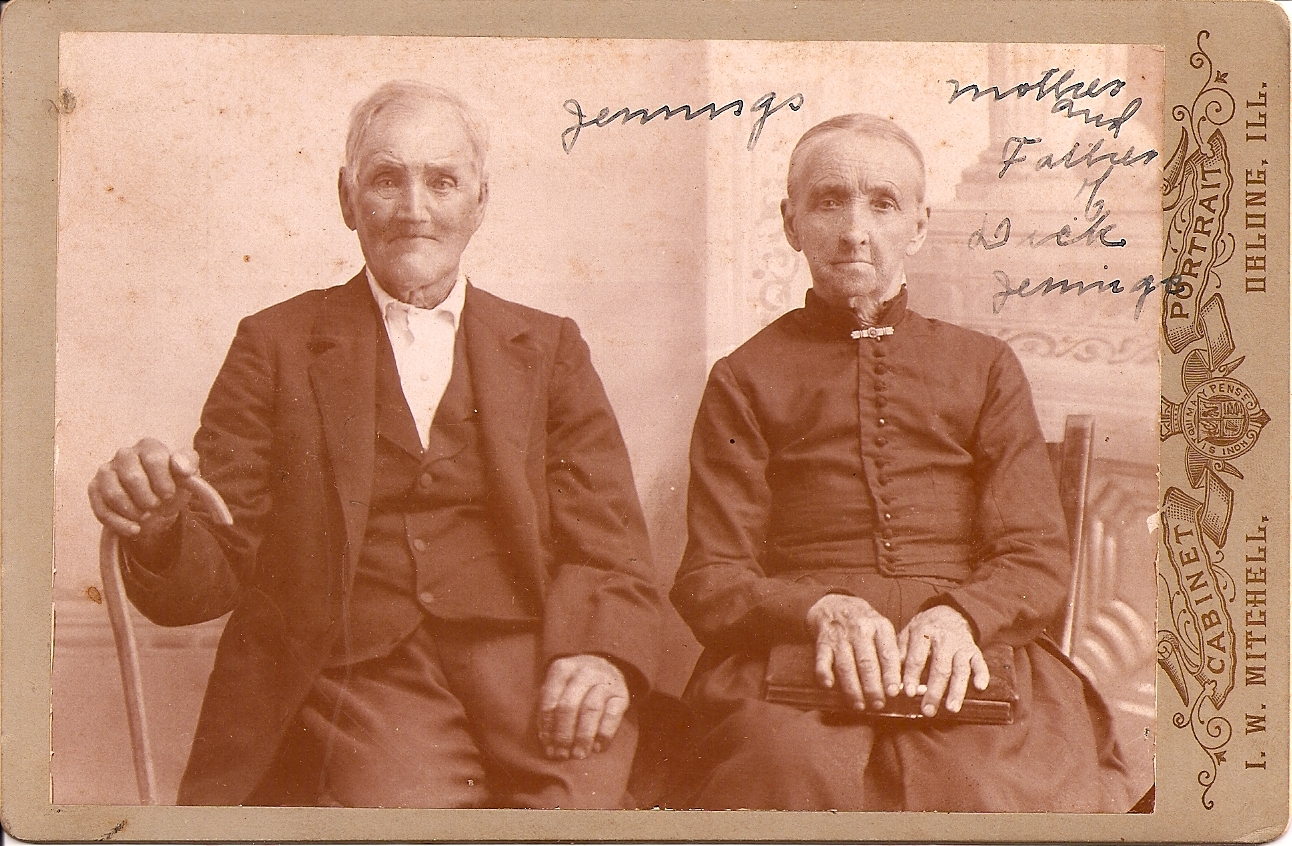
I'm also nearly vibrating with excitement about finding a possible picture of Jane (Nevitt) Browning Jennings, my third great-grandmother! Jane was born in 1819 and married her step-cousin James Browning (Jane's mother Rhoda's second husband was James Browning's mother Margaret Markee's brother -- got that?) in 1839. After James died in 1852 she married William Jennings, an older man from England. They had one son, Richard, born in 1861.

Here's where it gets interesting. I located a Find-A-Grave memorial for Richard and his wife, Mary 'May' (Lackey) Jennings. I read through Richard's memorial and it mentioned an entirely different set of parents for him -- Cyrenus Jennings and an unknown woman.

I contacted the holder of the memorial. She and I have been corresponding the last couple of days, comparing notes, trading stories, looking at proofs. She's known descendants of May's family members and has stories passed down as well as owning this picture I mentioned, and Richard's violin. I'm pretty sure that Richard is William and Jane's son -- for starters I have he and Mary's marriage license and it states his parents were William and Jane. As Cyrenus Jennings was born around 1845 and Richard in 1861 that would mean Cy would only be about 15 or 16 years old at Richard's birth! Possible but unlikely, especially given that his mother would likely be even younger. However, more speculation is useless without proof. I'm hoping we'll get more of it when I get to Robinson and spend the day in the courthouse and pouring over old obituaries in the Robinson Public Library.

If the picture she has (take a look at it here) is indeed Richard's parents, perhaps it's a picture of William Jennings and Jane (Nevitt) Browning instead of Cyrenus Jennings and his wife! So my next question is, of course, what year was this picture taken? It appears the man might be in his late 70s or early 80's and the woman might be in her late 60's or early 70's. I don't know when William died but he was born around 1803. Jane was born in 1819 and died in 1894. The handwriting is May's and says it's "Dick's parents." However, when was that written? Did May know William at all? And what about Jane? Jane died a year before May and Richard were married.

So okay, the photographer then. The photographer is Isaac W. Mitchell. I looked him up in the census and found that he was a house carpenter in 1880, living next door to a Bussard (who, while not a photographer, was likely a relative of the Bussards that were.) However by 1900 Isaac is in Oblong and is listed as a "Cooper and Photographer." By 1910, however, Isaac is listed again as only a house carpenter. Hm. Is it safe to infer that this picture was definitely taken after 1880 but before 1910? Argh! So many questions. More research is needed!

I've been thinking a lot about my great-great-grandfather Joseph Browning lately (Jane's son and possibly Richard's half-brother.) I was curious about what happened to the boy that accidentally killed him.

Miles Hughes, the son of James Hughes, was 18 in June of 1916 when he accidentally struck Joseph on his bike in downtown Palestine, Illinois. Joseph turned to avoid a puddle and caught the front bumper of Miles' car. All the witnesses said it was an accident and noted that Miles was going quite slow and that he couldn't have avoided it. There's a line in the paper about the accident that says, "It was one of those deplorable accidents which often occur and in which neither party is to blame." Living in today's world, that's remarkable isn't it? These days that boy would be charged with vehicular manslaughter or something like that and probably served with a civil lawuit as well. Honestly, it was just an accident. Sometimes that is all it is. In this regard, times really were simpler then.

Miles Fife Hughes, son of James Hughes and Mattie Fife, was born c1898. James and Mattie were married on 5 Aug 1891 in Crawford County. I know that Miles was living on Main Street in LaMotte Township in Crawford County in 1920 with his mother, who was widowed by that time. In 1930 he was still living with his mother on 410 Main St. in Palestine. I don't find any record that Miles ever married. I believe Mattie died in Dec 1935 (the online death record says 1925 but I think that's in error) and Miles himself died in Danville Twn. in Vermillion County, Illinois, on 31 Aug 1940. He was only 42 years old.

I wonder what Miles felt like going through life knowing he'd accidentally killed an old man? I know that it would haunt me even if there hadn't been any way for me to prevent it from happening. Well, if it helps, Miles, wherever you are.....it wasn't your fault.

Tuesday, March 31, 2009

Tombstone Tuesday, or Why I Should Stay Away From Cars

At right is the tombstone of Joseph Browning, my g-g-grandfather. Joseph was one of the sons of James Browning and Jane Nevitt (See "The Browning Series: Pt. 1 - James and Jane" in my sidebar for his parents.) I've written about Joseph before; I wrote about his Civil War heroics in this post. I own his original discharge papers and his original National Guard papers as well as a picture taken of him around 1864 when he was in the war. I have all his pension papers and even the pocket watch he used to carry.

Tonight, though, I've chosen not to speak of his interesting life. I'm sure I'll get around to that at some point since he was such a fascinating man and there's always more to say than I have room to! No, tonight I speak of his equally interesting death and how it eerily parallels another of my ancestor's deaths, the death of Robert Elbert Garrard. My grandparents were Virgil Joseph Browning and Beulah Ethel Garrard. Joseph is my grandfather Virgil's grandfather. Robert was my grandma Beulah's father.

The year was 1916. Joseph was 74 years old and living in Palestine, Illinois with his third wife, Francis "Fanny" (Daugherty) Higgins Seaney Browning. According to family tradition he had decided that afternoon to go pick up some things at the local grocery. Palestine is a tiny town now, so I can only imagine its size then. Joseph hopped on his bicycle and began to pedal into downtown. Now I don't know exactly how many cars there were on the road in 1916, but I can't imagine there were enough to put a body in too much danger in a place my dad calls a 'poke and plumb' town -- poke your head out the window and you're plumb out of town. So what were the odds that on this afternoon, Joseph would climb on his bike and get himself struck down in the street by a passing car?

Apparently pretty good. He did exactly that. A young man of 18 named Miles Hughes ran him over but it doesn't appear to have been the young man's fault. It appears that my aged g-g-grandfather turned himself into the path of the vehicle and was struck, breaking his leg and doing enough internal damage that he died 5 hours later of a cerebral hemorrhage. The article about his death was given to me by a cousin whose great-grandfather had saved it all these years. It is shown to the left; click to read!

Fast forward. The year is now 1938. We move to the town of Robinson, about 10 miles west of Palestine. After a leisurely afternoon meal over at her parent's house, my grandma Beulah begins to help her 78-yr old mother Louisa Adaline (Eagleton) Garrard clean up in preparation for a night of visiting. Her 85-year old father Robert Elbert steps out of the house and crosses his front yard to attend to his business in the outhouse.

He is on his way back when tragedy strikes. Across the street a little girl about five or six years old is sitting in the front seat of her father's car, waiting for her daddy to 'wind up' the car. Back then, grandma said, many cars had a crank that you had to wind to get it to go. Her father was cranking up the car and somehow that little girl pushed or pulled or knocked the car out of whatever the old term for 'park' was. It shot out across the street and over the curb and hit Robert as he was re-crossing his lawn to go back inside. He didn't die instantly but he was as internally damaged as Joseph had been. He lasted a few hours before finally passing away.

Now what are the odds of THAT?

Oh, it gets better. When I was 13 I was riding my bicycle home from school. You see where this is going, don't you......?

Yes, I got hit. A man driving a pickup hit me in the middle of the road. I looked both ways that day -- I remember doing so very well, because that was what I always did on that corner. The police said later that he was going about 45 mph and it was lucky I saw him in time to leap off my bike or I might've met the same fate as my two grandfathers. As it was, I suffered a broken wrist and a broken leg. My bike was mush of course. And oh yes, the guy who hit me? His name was Elvis.....

You can't make this stuff up.

Tuesday, March 3, 2009

Tombstone Tuesday - William Finley Eagleton (1862-1902)


For Tombstone Tuesday I thought I'd contribute the following picture and story about my great-great-uncle William Finley Eagleton.

(Thanks for taking the picture and putting it on Find-A-Grave, B.J.!)

William Finley was my grandma Beulah's uncle, her mother Louisa Adaline Eagleton's brother. He moved off to Colorado at an early age and the family never knew what became of him.

It wasn't until a while later that I unearthed a relative of Finley's -- one of his daughter's descendants. She was able to tell me what had happened and provided me with the article that I have included here. You can click on it and read it for the details. It is certainly a sad story but at the same time it is interesting to read how much reporting has changed in the last century. They didn't have any problems reporting about possible suicides nor did they refuse to reveal names to protect the identities of the innocent.

Fin's accident was just that -- an accident. I hope it was quick.

When I found out what had happened to him I told my grandmother. She said she wished that she could be given the chance to explain to her mother where her brother had gone to. He just disappeared and they never did hear from him again.

He certainly hadn't meant it that way.

William Finley Eagleton was born 2 Feb 1862 in Crawford County, Illinois, the son of Pvt. David Newton Eagleton and Margaret Jane Conrad. He married Eva Margaret Goddard on 30 April 1897 in Jamestown, Boulder Co., CO. He died of an accidental gunshot wound on 6 Jan 1902.